


Hancock County Master Gardeners Association

Helping Others Grow

Ask a Master Gardener
Public Calendar
Resources
Follow Us
  • Home
  • About Us
    • Become a Master Gardener
    • Educational Recordings
    • Newsletters
    • Who We Are
  • What We Do
    • Community Activities
    • Monarch 911
    • Scholarship
    • Soil Squad
  • Contact Us
  • Members Only

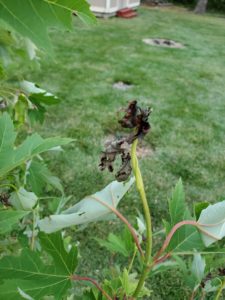
Barbara asks why second year Columbine is not blooming.

August 10, 2020 By Don

This question was submitted by Barbara. Researched and answered by Advanced Master Gardener Elaine.

What is your question for a Master Gardener?

I have what looks to be a columbine plant that I planted from seed. This is the second year for it and I thought it would bloom this past spring but it did not. Why? It is very large. I live in Indy

Barbara,

In answer to your question about the Columbine you started from seed, (and, yes, the picture you sent is definitely Columbine) I would be patient. When started from seed, Columbine may not bloom until the second or third year. They are short-lived perennials but, fortunately, are prolific re-seeders. I would say that your plant should bloom next Spring. Then prepare for many more Columbine coming up the following year. I’ve had them come up between the cracks in the sidewalk. They can tolerate a variety of conditions and are practically pest-free, except for leaf miners. In the wild, I’ve seen them growing in dense, dry shade out of the side of a sheer rock clift. The garden variety seem to have retained that spunky DNA.

Your Columbine looks healthy in the picture so it has probably been spending the last couple years developing a good root system. More than likely, you will be rewarded with beautiful blooms next Spring.

Thank you for visiting our website.

Elaine
Hancock County Master Gardener Association

Filed Under: Ask A Master Gardener

Lilacs and Hydrangea – When is the best time to plant?

August 3, 2020 By Don

This question was submitted by Sara. Researched and answered by Advanced Master Gardener Elaine.

What is your question for a Master Gardener?

I have purchased Lilacs and Hydrangea for my yard in New Palestine. They are in those buckets from Home Depot. I know the best time to plant is Fall or Spring. Should I wait to plant these until September? thanks

Sara,

It’s good to hear from you again. It sounds like you’ve been busy in your yard.

You are correct that the best time to plan shrubs (or trees) is either Spring or Fall. Fall is usually the preferable time if you are looking to lighten your workload as there is less time until frost to have to water the specimen ( studies have shown root growth to occur down to 40 degrees F.). Otherwise, with Spring planting, you will need to make sure the plant has sufficient water to sustain new root growth the first year. If It is a year with drought, you will be spending a lot of weeks doing that. With Fall planting, the roots should have enough time to establish themselves before the plant goes dormant. The one guiding principle to remember when adding something to your landscape is without a sufficient root system, you have no plant. So when it comes to deciding when to plant something, let that be your guide.

While most sources recommend not planting a woody plant in the middle of summer when temperatures are high, interestingly, I found at least two sources that indicated it can be done for plants grown in containers, which sounds like what you have. You should not attempt planting a bare root or “balled and burlaped” tree or shrub in the middle of the summer. This is because the root systems of both types have been disrupted and planting during the hottest part of the season will add even more stress to the plant. Those trees or shrubs grown in containers have root systems that will not be as disrupted and MAY NOT be as stressed. However, I would use caution if you decide that you want to plant now. I would plant the shrub in the evening as temperatures are cooling down. Water profusely. Do not fertilize at planting as that will add more stress to the plant to produce foliage. Remember, root growth is your focus the first year of a plant’s life. You can fertilize once the specimen has established itself. Do not heavily prune at planting; only remove dead branches, etc. Be sure to check everyday for signs of stress. Water thoroughly when rainfall is absent or insuffient. The shrub will need a minimum of a gallon a week; more when it’s extremely hot. The goal is to make a smooth transition from the pot to the ground and irritate the plant as little as possible.

If you can wait until September to plant, that would be ideal, however, there are situations where it is not practical to leave the specimen in the pot. If something appears to be very root bound, it needs to come out of the pot. You can replant it in a large pot and wait until September but if you have nothing larger to put it in, then you might want to go ahead and plant it.

There are few woody plants that can be planted most anytime, except when the ground is frozen, but Lilacs and Hydrangeas are not one of them. If you do decide to plant them now, just be very attentive to their needs.

Happy gardening,

Elaine; Hancock County Master Gardener Association

Filed Under: Ask A Master Gardener

Huge Green Caterpillar With Eggs on my Tomato Plant

August 1, 2020 By Don

This question was submitted by Jerrilee and researched and answered by Advanced Master Gardener Elaine.

What is your question for a Master Gardener?

There is a huge green caterpillar on my tomato plant with white things (looks) like eggs covering it?

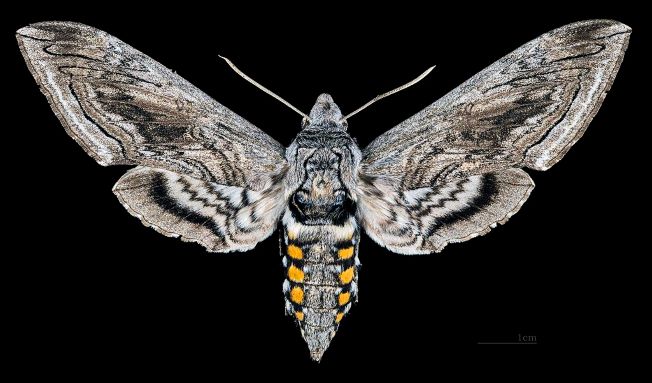
The caterpillar you referred to in your question is likely a Tomato Hornworm (Manduca quinquemaculata) or it’s close relative the Tobacco Hornworm (M. sexta). They both feed on plants from the Solenaceae family which include tomatoes, eggplant, peppers, and tobacco. The Tomato Hornworm has diagonal white stripes along the length of its body and the Tobacco Hornworm has V- shaped markings along it’s body. The adult form of the Tomato Hornworm is the Five Spotted Hawkmoth, sometimes referred to as a hummingbird moth.

The white structures you saw on the Hornworm on your tomato plant are, indeed, eggs and you are in luck. The Hornworm has several what we call “biological controls” in nature. More than likely, the eggs were laid by a parasitoid wasp with the biological name of Cotesia congregatus. As the larvae of these wasps grow, they consume the internal organs of the Hornworm and it eventually dies. The hatching wasps will not bother your tomato plant. The Hornworm, however, can consume a lot of the Tomato leaves, causing the plant to weaken. Therefore, it is recommended that you do not remove the Hornworm if you see eggs on it. Because the life cycle of the wasp is dependent on the Hornworm, you want to let the eggs hatch so there are more wasps to control the population of Hornworms. For Hornworms you find that have not been parasitized with eggs, you can remove them and put in soapy water. All the sources I found did not recommend insecticides and suggested that they be used as a last resort. Remember, most insecticides are not selective so you would be killing beneficial insects along with the Hornworm. And in this case, that wasp is considered a beneficial insect.

Attached is a picture of the moth that the Tomato Hornworm turns into if the wasp doesn’t find it first.

Thank you for visiting our website.

Elaine; Hancock County Master Gardener Association
Filed Under: Ask A Master Gardener

A local vegetable gardener asks; why is my cucumber plant not producing fruit.

July 23, 2020 By Don

This question was submitted by a local vegetable gardener. Researched and answered by Advanced Master Gardener Bruce.

What is your question for a Master Gardener?

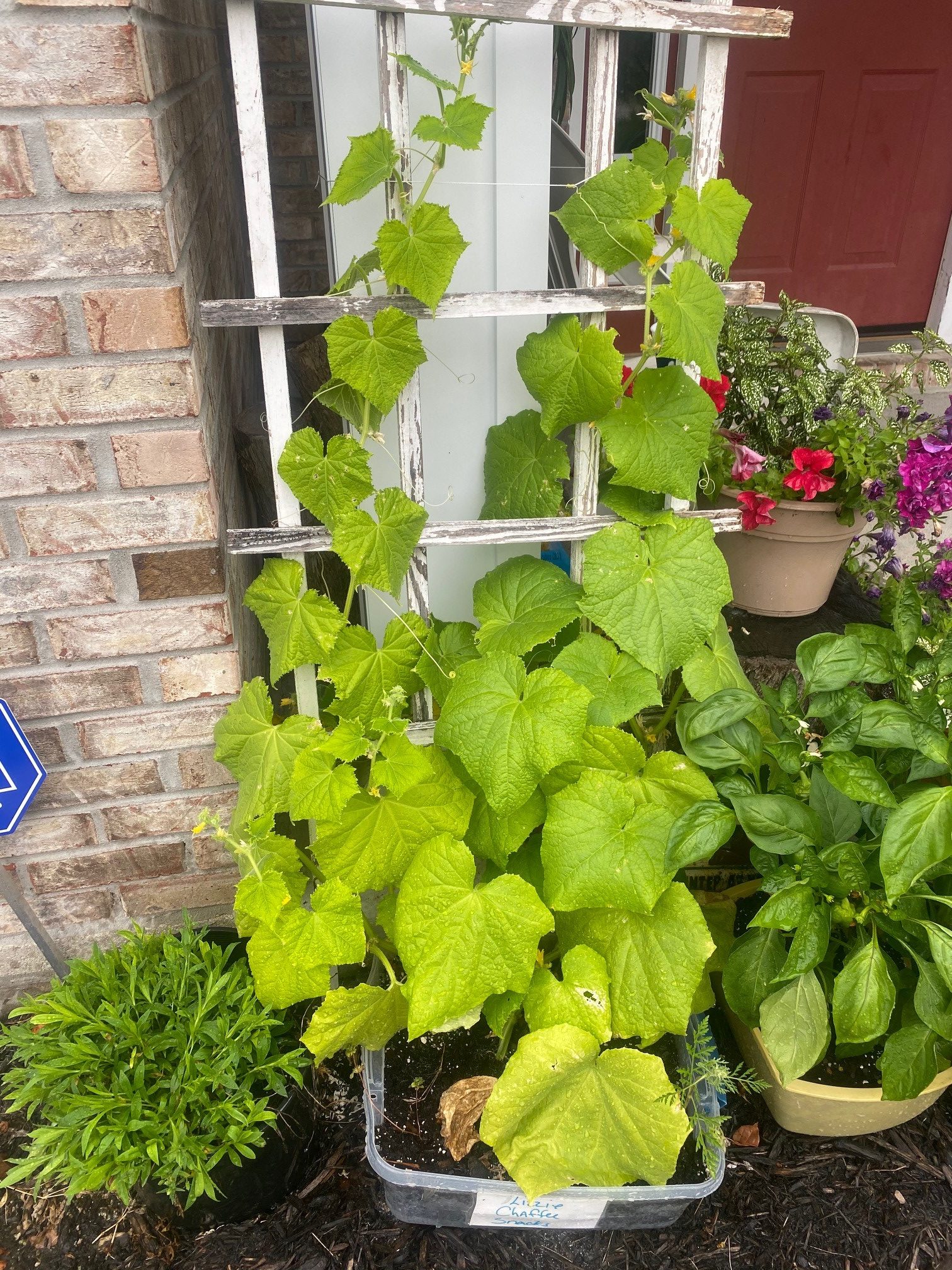
I have two cucumber plants that initially produced one cucumber but since has not had any. There are plenty of blossoms. It gets watered once a day. The soil seems to be damp but not overly. These are container garden plants with holes in the bottom to allow drainage. (See photo) We had just hoped to grow some veggies for my kids this summer to help with groceries. Any help would be greatly appreciated. I also have a green pepper plant that has lots of young peppers next to it. I don’t know if this has any impact. Do they need to be separated farther to allow for more sun to the blossoms?

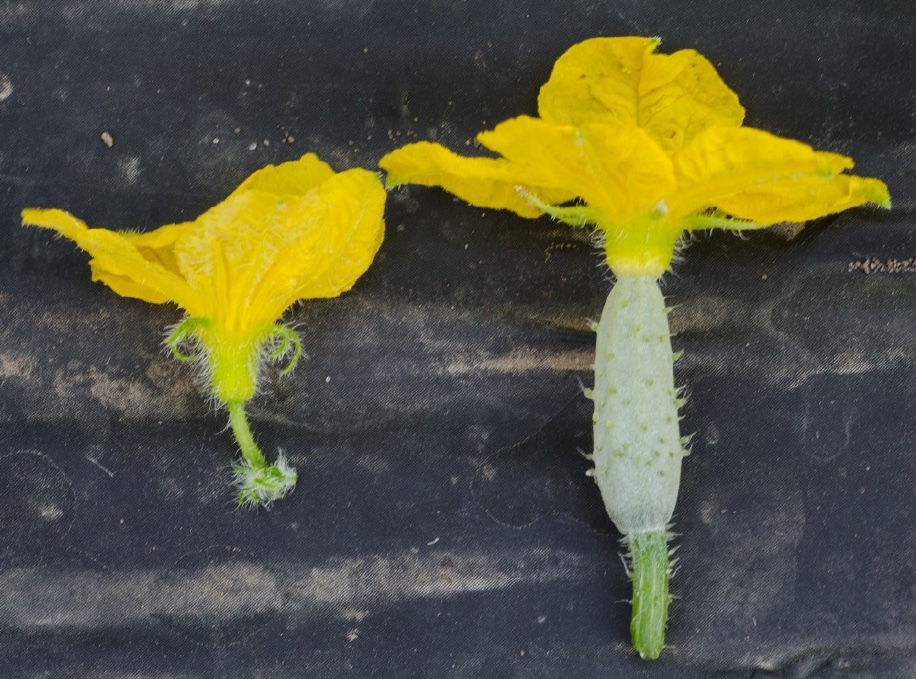
Sorry your cucumber is not bearing fruit. The cucumber plant produces a male and a female flower (see photo). The female has an elongated and thicker stem than the male. Both must be flowering at the same time for a cucumber to form.

Bees and other insects will usually pollinate the female plant. If you have both types of flowers and you are still not getting fruit then there are no pollinators around and you can step in and be a pollinator. Take a small paintbrush and wipe the inside of the male plant to collect pollen then take your brush and wipe the pistil (white growth in the middle of the female) with the brush and pollen attached to it. You can then watch for the cucumber to start growing behind the female flower. There are times when the plant only produces male flowers. In cucumbers, if the temperature is above 85 degrees the plant may only produce male flowers. You may need to wait until we get this hot spell before the cucumber produces a female flower. That is why you got an early cucumber and none lately. Looking at your growing container it looks like the soil is only about 6 inches deep. That could be affecting the productivity of your plant. Typically, use a five gallon pail filled to the top with soil. While the cucumber sends out shallow roots it will also send out a taproot that can grow up to three feet deep.

The pepper plant placement does not appear to interfere with with the Cucumber plant however, remember both plants need at least 6 hours of direct sunlight a day. If you have any additional question, please contact us again. I hope this helps.

Bruce


Filed Under: Ask A Master Gardener

Sara Asks; What is the best time to plant new trees.

July 22, 2020 By Don

This question was submitted by Sara. Researched and answered by Advanced Master Gardener Bruce.

What is your question for a Master Gardener?

What is the best time of year to plant trees (not evergreen or fruit trees) that are purchased from a nursery? Is there special soil mix to use when planting them? New Palestine IN area.

Thanks Sara for your question on tree planting. Spring and fall are the best times to plant trees. Since there is a better selection of trees in the spring, I would take advantage of the selection and plant in the spring. When planting a tree or actually anything, do not plant if the ground is soggy or overly wet. Planting in soggy soil will alter the soil structure (even clay soils) which will add stress to your tree. When planting the tree, backfill with the soil you dug out of the hole. Spread mulch on top of the soil and it will work it’s way down to help break up the clay soil. Plants that grow through different types of soil will not grow as quickly as growing through the same type of soil even if it has high clay content. Attached are a couple of videos from Purdue on planting trees. Lindsey Purcell is probably the best authority in the state on trees.

https://www.youtube.com/watch?v=k5rUgd7BmiA&t=72s

I hope this helps. If you need any additional information, contact us again.

—
Bruce

Filed Under: Ask A Master Gardener

Kathy asks; What are the brown spots on my tomatoes

July 17, 2020 By Don

What is your question for a Master Gardener?

This question was submitted by Kathy and answered by Advanced Master Gardener Bruce.

I’ve been trying to grow tomatoes for years but something always happens! My plants have looked very healthy so far but today I’ve noticed several tomatoes with what looks like blossom end rot but on the SIDE of the tomatoes. None of the black spots are on the actual bottom. I’m so sad! I‘m hoping this is a problem I can correct!

Blossom End Rot on Tomatoes

Hi Kathy, thanks for contacting us with your question with black spots on your tomatoes. You mentioned it looked like blossom end rot and you are entirely correct. It is blossom end rot which usually shows up on the end but can develop on other areas of the tomato. It is caused by a calcium deficiency either in the soil or insufficient moisture to transfer the calcium from the soil to the tomato. Remedies include:

Mulching around your tomato plants to help with water retention

Monitor soil moisture and water when necessary,  1 to 1 & 1/2 inches a week. And be sure to water from the plant bottom to help minimize disease.

Use a fertilizer high in superphosphate like a 4-12-4 or 5-20-5. Too much nitrogen can limit the uptake of calcium.

Having your soil tested so any problems can be fixed at the beginning of the season.

The rot is fairly common this year. Rain has not been consistent, we have had some very hot weather early in the season, and it seems to have been quite windy which also helps dry out the soil. You should be back to growing delicious tomatoes in no time once the moisture level is consistent. Let us know how your tomatoes are doing.

—
Bruce


Filed Under: Ask A Master Gardener

Bee Balm With Powdery Mildew

July 14, 2020 By Don

What is your question for a Master Gardener?

This question was submitted by Sherry and answered by Advanced Master Gardener Bruce.

I have a three year old patch of bee balm. Gorgeous and seemingly happy , healthy, and spreading more each year and then mid June comes the powdery mildew. Now it is looking spindly, blooms and the petals just fall off immediately. In the past I have removed the stalks that show the powdery mildew and the plant just doesn’t do well. Should I pull this entire plant? Destroy it away from any other plants? treat the soil?

I would love to save it but I am not confident that will happen.I adore the plant and want to plant more next year – any recommendations? My location is Hancock County and I have attached a picture of the plant.

One more quick question – is it ever too late in the summer to plant new perennials?

Thank you and look forward to your response.

Bee Balm with powdery mildew spots

Thanks for contacting us Sherry with your question concerning powdery mildew on Monarda (bee balm). Unfortunately there is little that can be done in controlling or eliminating powdery mildew from plants.  Lower humidity helps in the control of mildew but we both know that’s not going to happen in Indiana.  The other suggestions are making sure it is in full sun and/or thinning out the stand of Monarda to help with air circulation which will slow the infection of powdery mildew.  If you thin out the plants, that will affect the impact of the color mass produced by Monarda?  I have added a link explaining powdery mildew.

To enjoy the mass of color provided by Monarda, you might want to consider investing in mildew resistant varieties of Monarda. I have included a link with a list of mildew resistant cultivars in case you decide to change.

It’s really never to late to plant perennials.  I shop season ending clearance sales all the time and don’t have problems planting them in late October.  The only exception is the 4″ squares of perennials. I only have about a 30% success rate of them coming up in the spring. In the future, I will stick the plant with the pot in the ground to overwinter.  If it comes up in the spring, I will take it out of the pot and replant it. If you have any questions, don’t hesitate to write back.  Good luck with growing!

https://web.extension.illinois.edu/hortanswers/plantdetail.cfm?PlantID=735&PlantTypeID=2

https://www.purdue.edu/hla/sites/yardandgarden/decrease-powdery-mildew-through-prevention/


Bruce

Filed Under: Ask A Master Gardener

Scott Having Trouble Growing Roses

July 13, 2020 By Don

This question was submitted by Scott. Researched and answered by Advanced Master Gardener Bruce.

What is your question for a Master Gardener?

I grew roses in Nevada and they were very successful. My attempts at growing roses in Indiana, not so much. Can you provide some basic tips on growing roses in Indiana? My thanks


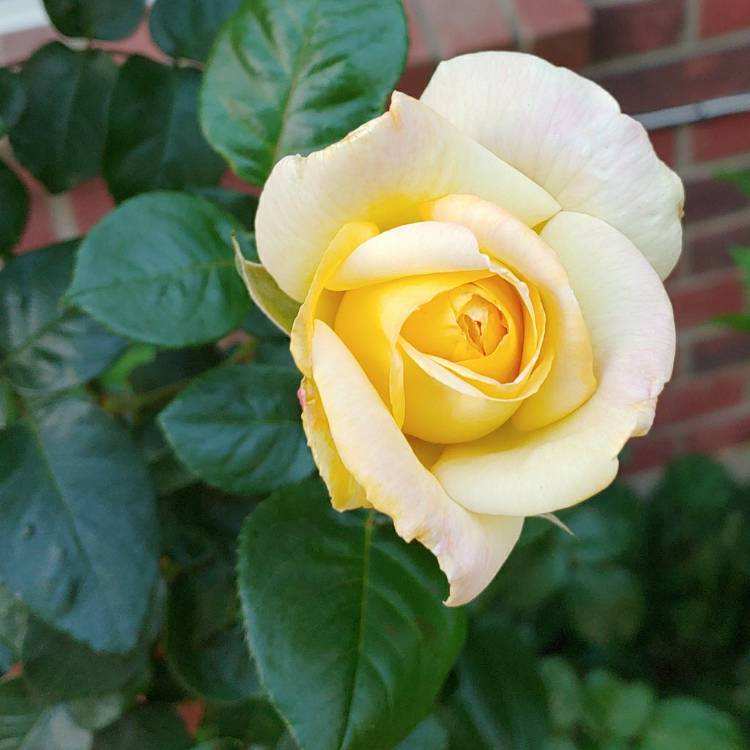
Rosa 'Madame A. Meilland' syn. Rosa 'Peace', Rosa 'Gloria Dei ...

Welcome to Indiana, Scott.  I’m sorry your rose growing experience is not as positive here as it was in Nevada.  I’m sure the humidity is a big factor in maintaining beautiful roses.  I have included a couple of links that may improve your experience in growing mid-west roses.  The first link suggests some cultivars that do well in this climate.  The other link is  rose care in a calendar form which probably varies from your experience from the West.  I hope these help.  Contact us again if you need any additional information.

www.bhg.com/gardening/gardening-by-region/midwest/best-roses-for-the-midwest/

https://www.kansascityrosesociety.org/rose-care-calendar.html


Filed Under: Ask A Master Gardener

Wilting Cucumber Leaves

July 10, 2020 By Don

This question was submitted by Diane. Researched and answered by Advanced Master Gardener Bruce.

What is your question for a Master Gardener?

I transplanted a cucumber plant from a big box store and it looked beautiful for several weeks. Lots of both male and female blossoms, large leaves (no apparent sign of bugs), and plenty of new growth. However, about once a week, all the leaves of one strand will suddenly wilt; the next day, the leaves are withered and dry, and in 1-2 more days, all the blossoms on that strand are completely dead. The rest of the plant looks fine. I originally tried using a solution of Dawn soap and peppermint oil, thinking it was bugs, but that didn’t seem to work (maybe I wasn’t spraying often enough?) I’ve stopped spraying since I’m not sure it was helping. I only have this one cucumber plant; it’s in a raised bed garden with one plant each of Cantelope, Watermelon, and Butternut Squash plants. The other plants look fine (other than I planted them later than I should have, so I might not get any fruit until very late in the fall). Any suggestions/thoughts on my dying cucumber plant? At this rate, I won’t have any cucumbers this year!


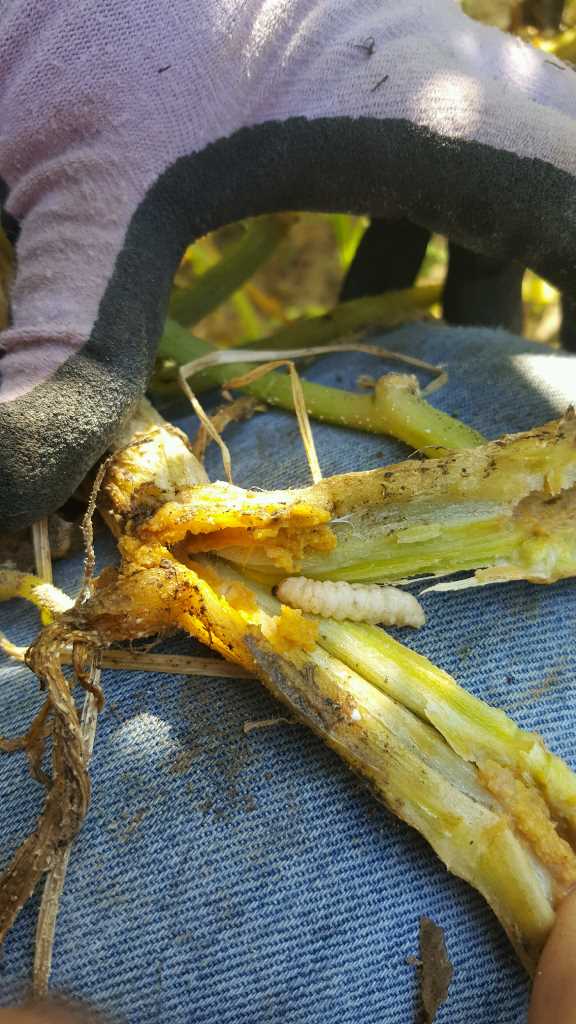
Closeup of a Squash Borer (Credit to Missouri Botanical Gardens)

Thanks Diane for contacting us with your wilting cucumber vine question.  Usually the main cause of wilt in cucumbers is bacterial cucumber wilt which is caused by an infected cucumber beetle. There is no cure for bacterial cucumber wilt.  The plant needs to be pulled and destroyed.  However, the second picture you sent may show another option for the cause of the problem.  Enlarge the bottom horizontal stem and you will see an opening in the cucumber vine.  I think you may have a squash borer that prefers cucumbers to squash.   To save your plant there are two methods to correct the problem.  Take a wire and insert it into the hole and run it up the vine to kill the grub that is eating its way through the interior of the vine. The other option is using an insecticide containing either bifenthrin, pyrethrin, neem oil, or carbaryl.  Direct the spray in the hole so it can reach the grub.  If you use a spray, follow the directions on the bottle for harvesting information.  If you have several stems, inspect all of them for the borer damage.  If possible cover the hole in the vine with some dirt or mulch.  This should solve your dilemma. Please let us know the outcome or if you have other questions.  Also check your butternut squash and watermelon for borer damage.


Filed Under: Ask A Master Gardener

Michelle Asks For Help With Multiple Tree Problems

July 9, 2020 By Don

This question was submitted by Michelle and answered by Advanced Master Gardener Bruce after a site visit, research and consultations with the Master Gardener team.

What is your question for a Master Gardener?

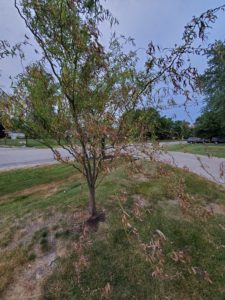
Hi! I have some concerns with trees this year and hope it is just due to the crazy weather (despite the fact I watered the young ones 3-4 times per week). I can email pictures if needed, but the concern is that the branches are turning black. All different types of trees, young and old. No signs when we had the late frost. All just started this past week. Thank you!


Hi Michelle  I hope you are doing well.  I have good news and bad news for you.

The good news, The Maple trees must have been damaged during the late freeze.  It should grow out of it by next spring.  The oak trees, most likely, suffered physical damage from the winds, the freeze, etc.  The tulip tree is OK.  May want to monitor your Redbud.  It’s only a couple of leaves but it is showing signs that water is not getting to the leaves.  A good watering every three to four days should return it to normal.  If not, let us know.

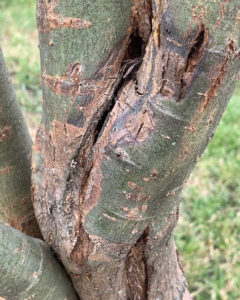
The bad news concerns your willow tree.  It needs to come out.  It has several cankers (lesions) which is causing its decline.  The cankers make it possible for insects and disease to get inside the tree and cause havoc. It is fairly common for willow trees to produce cankers.  I would not advise getting another willow tree as a replacement.  The picture below show the cankers I’m talking about..

WillowTreeCankers

I know you plan on adding more trees to your yard. I included a couple of videos that have some tips that will help with your trees health and growth. Contact us next spring before leaves start to form and I will help with your pruning.

https://www.youtube.com/watch?v=iIaYvtqY7-I&list=PLp7M5Aw8G6NM8hQpoaZyZF5ehxK3ikylt&index=6&t=62shttps://www.youtube.com/watch?v=k5rUgd7BmiA&list=PLp7M5Aw8G6NM8hQpoaZyZF5ehxK3ikylt&index=2&t=127s

Thanks for contacting the Master Gardeners of Hancock County for advice.  If you need anything further, don’t hesitate to contact us.

Final comment from Michelle:

Hi Bruce, I appreciate so much that you have taken the time that you have to help me with our situation. I am very grateful! I knew that willow trees could be delicate trees, but did not know what to look for.  This has been an educational experience.  I made sure to share your suggestions on pruning and staking the trees for support with my husband. I will be in touch for further assistance in the future.

Again, thank you so much!!

Michelle

Filed Under: Ask A Master Gardener, Trees

  • « Previous Page
  • 1
  • 2
  • 3
  • 4
  • Next Page »

Upcoming Events

Notice
There are no upcoming events.

Designed by CCM · Log in